Friday, January 11, 2019

Stories of My Life by Katherine Paterson

I'm pretty sure I have never actually recommended a non-fiction book to someone. So deep runs my love and admiration of fiction. 

That being said, I'm going to do the unthinkable, and highly recommend this book (by many-award winning children's author, Katherine Paterson.) So many things about this book were inspiring and encouraging to me....as a mother, as an aspiring author, as a Christian, and as someone who thinks of life as The Great Story Marketplace. 

In the introduction, she was clear that this is not a memoir. (After all, she had promised herself to never write a memoir.) But she also realized that, with the advent of a dishwasher in their home, her children had ended up missing out on hours of family history storytelling. So she wrote these stories--snapshots of her different lives, in China and America and Japan, in school, working, single, married, the modern award-winning author, and most recently, widow. 

As an author, it seems that she really started writing in earnest while she had three small children in her home. (My situation right now.) She mentioned that she started by taking a class or two and was trying to write some poetry every day. And then she thought, if she could just write a chapter a week, she'd have a whole book by the end of a year! (Which makes sense to me.) So it has been inspiring, realizing that it's ok--even good!--to start small, to practice being faithful in writing as an exercise of skill and brain power. And so, since I have children who love poems, and I have some interest in writing poems for them, Katherine Paterson has encouraged me to try writing a poem every week.

Katherine Paterson has been surrounded by Presbyterian ministers. (Her father was one, and she married one.) As a child, she grew up in war-torn China. An incredible prospect she presented: this faithful minister (her father) with his wife and five children, during the time when the Japanese were invaded China and committing unspeakable atrocities among the people. The threat of rape and murder of his entire family was very real. Twice they had to flee China, and when she got to America, Katherine felt that this was the inhospitable, foreign country. Between the story of her father, Maud Henderson (another missionary), and her own story of serving in Japan, I was blown away and humbled by the truly selfless and courageous love demonstrated toward the heathen people of China and Japan. As she wrote of her own journey toward Japan, Katherine mentioned that her fear and distrust of the Japanese ran deeply inside her from her childhood days in China. An yet, she felt that God was calling her to Japan, she prepared to go, and as she considered her four years there, she said that she wished everyone could "have a chance to be loved by the people they thought they hated." In similar fashion, Maud Henderson's humility and faithfulness cuts deeply in astounding ways. Her sacrifice and courage in protecting the daughters of China (hundreds that she cared for and raised in her home) as a single woman, amidst the terrors of Japanese occupation; my heart was wrenched once and again, and I felt that my own love was weak and pitiful in comparison. It's a stunning example of James' exhortation, "True religion that is pure and undefiled before God the Father is this: to visit orphans and widows in their distress and to keep oneself unstained from the world." 

As a mother, I found great encouragement both in her desire to parent well, and in the unmistakable fact that occasionally she didn't. Living in a place were hyper-sensitive "helicopter" parents are the norm, someone who lets their kids climb anything and everything and run around barefoot in 40 degree weather is bound to stick out like a sore thumb. I know I make some mistakes as parents, but my kids are happy and healthy, energetic and imaginative, and (I hope) are learning that life isn't about getting just what they want. Which, incidentally, is exactly what I've been shooting for. So as Katherine Paterson revealed some of stories she has stumbled upon (the ones her children would "never want their mother to find out"), there's a bit of encouragement there to know that those stories will be in every family. And all we can do as we seek the Lord is parent the way we see fit, and trust that God is the one who keeps our children happy, healthy, and faithful. 

There is so much more. But I think this is enough to give you a sense that, whether it's just to indulge in some interesting family stories of a world-famous (and completely admirable) author, or to be truly inspired in some area of life, Stories of My Life should be near the top of your 2019 to-read list! 

Saturday, December 8, 2018

On Reading Well by Karen Swallow Prior

This book was such a joy to read, being both interesting and easy to read as well as inspiring to immediately go out and read lots of other books! A few weeks ago, I posted about the introduction of this book, in which Karen Swallow Prior lays out her argument that reading (of the sort that thinks and assesses the content) is good for developing virtue. In the main body of the book, she takes 12 virtues (the cardinal virtues, the theological virtues, and the heavenly virtues) and considers each one in light of a particular work of fiction literature. 

While we could probably take just one work of literature and consider what it has to say about all 12 virtues, I appreciate that she wanted to give the broad spectrum--this book is essentially a lesson on how to look at books from a variety of genres and how to open ourselves to be changed for the better by the goodness and badness we find. She also helpfully considers what each virtue really means and looks like, seeking out clarifications through etymology and other uses of the root words. 

Also, in taking a different book to look at each virtue, Prior shows how we can apply this kind of careful reading to every genre. I certainly have my favorite genres, and she even write about two of my favorite books (A Tale of Two Cities for the virtue of Justice, and Persuasion for the virtue of Patience.) But she considers authors and styles that are widely different, which has since inspired me to look forward to trying out each of these styles, if not each of the books that I haven't yet read. The earliest work is from the 17th century--Bunyan's Pilgrim's Progress which is a Puritan allegory that she uses to think about the virtue of discipline. For more modern works, she uses George Saunders' short story "The Tenth of December" to talk about Kindness. In between we have F. Scott Fitzgerald, Cormac McCarthy, Mark Twain, Tolstoy (along with Dickens and Austen whom I already mentioned), Edith Wharton, Flannery O'Connor, and Shusaku Endo. 

It would be impossible to even summarize the points of each virtue for each book, since that is what Karen Swallow Prior has done in this book.... and it is a book! I can, however, summarize some of my favorite points and mention a few things that I disagreed with. 

The chapter on Faith (which looked at Shusaku Endo's book, Silence) was particularly helpful to me in realizing the danger of pride as we "work out our faith in fear and understanding" as Paul says in Philippians chapter 2. We conscientiously seek to know God and understand what he would have us do.... and before we know it, we can find ourselves looking at other people and thinking, "why aren't they doing what I'm doing?" (Perhaps not expecting them to do the very things we are doing, but we suspect that they aren't seeking God's will the way that they ought to.) I read Silence when I was in college and hated almost every moment of it. And in a way, I felt a bit validated in reading this chapter, because Prior speaks to the discomfort of the subject matter, as we see first one and then two missionaries to Japan apostatize and then become assimilated into Japanese culture. And the central question is, "do they have saving faith? CAN they have saving faith?" And there is no way to read the book and come out saying a positive "yes" or "no." Which is what frustrated me! But Prior points to this as the power of the writing, taking away the pride of the reader. We don't and we never will have the power to say decisively: this person is damned. But we can look at our own faith and say: is this real? And we remind ourselves that this is not our trial...but should it ever become ours, we borrow more words from Paul in Philippians and pray and ask God fervently that "with full courage, now as always, Christ will be honored in my body, by life or by death." 

This chapter on faith, by the way, did not make me want to go re-read the book again. (Perhaps the only one that didn't do that.) I think I still have an almost visceral repulsion to this story, it is so horrifying and unsettling. But I appreciate so much that I now feel like I have gotten the point (or at least one of the points) that I should have seen when I read it 10 years ago. 

Another favorite chapter was on the power of kindness. First, Prior draws the connection with kinship (among other things.) And through the story of Saunders' "Tenth of December", she draws out the power of treating other people like family. We love them, understand them, seek to understand them, and are careful about what we say (or should be), knowing that as family, we might hold more power over their emotions than we ought to. Kindness doesn't always have to go to this extreme, but there is a care and concern at the heart of it that can be directed toward anyone, even the passing stranger on the street. There is also an essential connection between kindness and truth. There is no way to separate the two. "Niceness" is different. Even the etymology of "nice" has an association with ignorance and lack of understanding. The story itself shows a meeting between two strangers in the woods--an old man who is terminally ill and preparing to kill himself, and a boy out pretending "rescue the damsel in despair". They meet, and they are kind to each other, showing concern for the other's health and basic needs. The result of this everyday sort of kindness is that the old man is revived in his desire to live (a sad irony, since he is terminally ill and now must consider the tough days in front of him.) Both he and the boy realize that they were living in a cloud, imagining things that weren't true. Because of their chance meeting in the woods and their kindness, they see the truth more clearly and are ready to meet life with their "eye's open" and ready to appreciate it.

Throughout the book, Karen Swallow Prior has a roughly Augustinian approach to virtues, understanding that they are a mean of behavior or thought between two extremes, which are considered to be the related vices. And throughout the book, I have taken some issue with this... sometimes with the extremes, and sometimes with the whole framework of a virtue being the middle ground between two vices. One example of this is the way she writes about patience. I love much of what she had to say in the chapter on Persuasion (it is, after all, one of my favorite books!) A helpful one-liner that I took note of was, "patience is not passivity, but perseverance." Part of her understand of patience is that it's "a willingness to endure suffering." This is linked to the following idea that if there were no suffering, there would be no need for patience.... which I don't think quite lines up with a normal/everyday understanding of patience and suffering. We have often told our kids that "Patience means waiting without whining or complaining." Perhaps if you have a very soft understanding of suffering, waiting for something could qualify.... but no, waiting in and of itself is not suffering. Now, I do agree that all moments of suffering require patience, but I don't think it follows that suffering must be present for a person to exercise patience. In reading Prior's assessment of the extremes associated with the virtue, I've probably become more set in my disagreement. She says that the vice of excess that is related to suffering is "wrath" (!) and the vice of deficiency is "apathy." And here is my objection: we are talking about patience! (not suffering) Excess and deficiency must be related to the thing in the middle! An excess of patience might result in apathy, but certainly not wrath and anger. And a deficiency of patience is.... well.... impatience. Impatience can sometimes (often does) lead directly to anger, but more closely shows an extreme selfishness and entitlement. She does end the chapter the with extremely helpful and succinct comment that "patience has often been considered a sub-virtue of courage." 

In spite of my disagreement about the framework she is setting up, I have found  most of her thoughts on the actual virtues to be wise and inspiring. I appreciate the many, many references she makes to other writers, theologians, and philosophers. And most of all, I have a better way of reading and practicing virtue at the same time--truly learning to be by doing one of the things I love best: immersing myself in fiction and literature. 


Wednesday, November 28, 2018

The Vanderbeekers of 141st Street by Karina Yan Glaser

Three chapters in, I thought this book was such a bore. But now that I've finished it, I'm looking forward to reading the sequel that came out just a couple months ago (The Vanderbeekers and the Hidden Garden). What changed? Instead of being impatient with a slow plot, I became so engaged with the characters that I was more interested in their own development and emotions than in the resolution of the central question--which is: Will they have to move? And where? 

While I love a good fantasy book full of imagination and magic and creative settings, every once in a while I need to sit down with a real-life story about normal people with normal problems. The Vanderbeekers of 141st Street is just such a book, and ideal for an early grade school audience. 

This book is appealing to me largely because it's clearly an homage to all lovely homes in the world. This family has made their home in Harlem in Manhattan, which is hard for me to relate to. But there's no doubt that the picture that Karina Yan Glaser paints is very attractive. The Vanderbeekers are an in-tact family of seven (living in Manhattan... which perhaps requires a bit of suspension of disbelief right up front): father, mother, and five kids (plus dog and bunny!). Mr. Vanderbeeker grew up in this particular neighborhood in Harlem, as did all of his kids up to their current ages, and even in this particular house for the last 6 years or so. The Vanderbeekers know everyone in the neighborhood and help take care of the elderly and thoughtfully include those around them in their lives. It's a beautiful picture of the way all people are meant to live in community. A personal favorite moment is a snapshot of how comfortable the family is with all different sorts of people when a "gentleman" in baggy pants with a rhinestone studded dog leash out walking his chihuahua who, upon seeing a contingent of the kids, greets them with, "What-up, Vanderbeekers?" (Even though I would not normally think "gentleman" when seeing a person of this description, I love that he is labeled such in the book, showing that the children see him that way and have a way of treating all grownups as "ladies" and "gentlemen" no matter what stereotype they might fit into.) 

Of course, the family is a bit loud. How can you not be loud when there are 5 kids in one family? In fact, their noise and conspicuous presence is part of what causes their landlord to decide not to renew their lease. So the kids develop a hair-brained (and ill-fated) scheme to capture the heart of the evil Beiderman so he will change his mind and let them stay. The plan includes everything from offerings of homemade place-mats, a kitten, threats a la Treasure Island, and a neighborhood petition to show how Harlem would not be the same if the Vanderbeekers had to move. 

The story is simple and fairly slowly developed. The whole book takes place over about 4 days surrounding Christmas. But each child, and both parents are fondly sketched--each their own delights and sorrows and dreams and memories. They are altogether charming. This book does much to affirm the goodness of a family, both for the members of that family and also for the good of the community that surrounds the family. 

Wednesday, November 14, 2018

A healthy diet of fiction

I'm currently reading a book called On Reading Well, by Karen Swallow Prior. This is certainly not my usual realm (which I can confidently say is either literature or children's fiction) but rather a dabble into literary criticism with a Christian twist. This book in particular, has the distinction of being an argument for the moral benefit of reading fiction. (Which is not too common today, especially among Christian circles.) So I refrained from writing another book review this week, partly because it seemed a bit much to review books by the same author three weeks in a row, and partly because I'm well into the middle of a book about reading, that I would rather share with the world at large. 

While I'm not at all trained in literary criticism, I have read other books about writing and about assessing the strength and value of the writing that we read. I'm also fairly well read, in the sense that I have read quite a lot and I can articulate both the good and bad points of the books I read. And not having been classically trained in literary criticism, it feels rather validating that in reading this book, my common-sense approach to determining what is good and bad seems to be upheld. (Though this style of literary criticism is considered, at best, quaint in these modern times.) 

Good fiction makes us want to be good people. There. Now isn't that quaint? But it's true.... 

This is what Karen Swallow Prior argues so compellingly in her introduction. 

Virtue is desirable for a good life. And virtue comes, not from knowledge, but from practice. Knowing what is virtuous doesn't make us so.... it's acting virtuous that makes us good people. And how do we learn to act virtuous? By being placed in circumstances where we must choose between right and wrong and we succeed in choosing right. And how do we know what is right and virtuous? Perhaps a couple ways: one way is to call to mind an example that you admire of virtuous behavior. We imagine, "what would so-and-so think or say or do in such a case?" This is the benefit of history. We can think of a specific example with personality that inspires us and with which we can sympathize in their victories and defeats. A second way to know virtue is from philosophy. We think hypothetically about what is perfect and to be desired above everything else in beauty and goodness.... and we form an ideal. 

This is what makes fiction so very powerful. Because fiction is the only place where the ideal (philosophy) can meet the picture (history). In reading a fiction story, we relate to the protagonist (and indeed, all the characters!) in their vicissitudes and we feel the pain of their bad decisions and the glory of their good decisions. We see with an almost omniscient eye the ramifications of their actions and the events leading to the fateful dilemmas that must change the course of their story. In essence, we are so emotionally invested that when we read a book that paints the world in strong and true colors (that show accurately the pain of 'bad' and the joy of 'good'), we are mentally practicing to make the same decisions in our own lives. 

If people become virtuous through practice, reading fiction is a way to practice making good decisions alongside the characters that we read about. Of course we recognize that we aren't really in the same situation.... and yet, we think through the decision as if we were. That's why it's a practice! And it helps train our minds and our hearts to desire to do well and to be worthy of greatness in the real world. Karen Swallow Prior also suggests that even though we aren't truly living out these situations requiring a turning toward right or wrong, we often aren't fully living out our own scenarios even in real life! Yes, we're living, and actually making decisions. But we often don't see (as we do when we're reading) the ramifications and ripple effects of the decisions we're making. We don't see all the movements around us that have brought us to this place. We don't see the history of many years condensed into a mere hundred pages that we have perused over the last couple days to give us a rounded and broad understanding of the virtues and vices that have come this moment to war over our souls. But! The more fiction we read, and the more we practice seeing these things in the books we read, the more we are ready to consider the story of our own lives with greater wisdom and discernment. 

This has certainly been true in my own life. I can easily rattle off a half-dozen fictional characters that have literally changed the way I think and live simply because I have read and re-read and loved the books in which they are cast. And now, in being reminded of the value of their example, I'm once again inspired to search for more, and to be reunited with my old heroes that have brought me to my current place and still have much to teach me. If you don't have fictional heroes, you are missing out on a very great blessing and help toward finishing your own story well. 

Wednesday, November 7, 2018

Ghosts of Greenglass House by Kate Milford (book review and character summary)

A new mystery, a new search, and a new bunch of crazy people--Ghosts of Greenglass House is everything you would expect of a sequel to Kate Milford's award winning Greenglass House. 

The craziness begins anew when, just a couple days before Christmas, the Wait's show up at the front door of Greenglass House. Who are the Waits? A mysterious and slightly creepy caroling group. They wear outlandish costumes covered in bells and holly and mistletoe and they carry a "hobby horse"--an animal skull bedecked with ribbons and bells and candles. But then, for some reason, everything starts going wrong. The cleaning of the chimney is a complete disaster, filling the air with soot and grime. One guest seems to get poisoned by some punch (someone put Christmas berries in with the spices!) Two other guests are whacked on the head by an unseen molester. 

It seems impossible that all this is coincidence when only the day before, Georgie and Clem showed up at the Greenglass House seeking a  low-profile haven after a job gone wrong. And sure enough, the same evening that the Waits are spreading chaos over the Greenglass House, Georgie and Clem both find that they have been robbed. As far as they can tell, the stash they brought wasn't particularly valuable--just special because it once belonged to Violet Cross, the famed smuggler who supposedly did the impossible and mapped the ever-changing Skidwrack River. Such a map would be an invaluable treasure! It doesn't seem like the map was among the things they found in the old hideaway, but if it was.... things could get a lot messier than a bit of soot on the Christmas tree! 

To complicate matters even more, there's another mystery guest: Emmett Syebuck. He appears to be at the house as an artist obsessed with the stained glass windows. But is he really who he says he is? He clearly has some skill. But his interest in Clem and Georgie when they arrive is more than a little suspicious. Is he the another thief? Is he working for himself? Is he a customs agent? 

In contrast with the first book, Milo learns to use his emotions (instead of ignoring or dampening them) to strengthen his understanding and intuition of those around him. Like the first book, this story draws on the uses of a role-playing game (Odd Trails) to help Milo adapt to new situations and learn how to be a more capable, calm version of himself. And like the first book, there are several side-stories told by the characters--and it is for the reader to determine just how relevant they are to the mysteries at hand. 

All in all, Ghosts of Greenglass House is a fun and fast read that follows well in the footsteps of Greenglass House. Stay tuned for my thoughts on Bluecrowne--the Nagspeake companion novel about the magical first inhabitants of Greenglass House (the Bluecrowne family.)


For those who have taken some time in between reading the first and second book, it might be helpful to have a refresher of characters and summary of what happened in the first book: 

Milo Pine (and parents) - Mr. and Mrs. Pine, with their adopted son Milo, live at Greenglass House and run it as an inn. While not actively participating in smuggling activities, it's generally understood that Greenglass House is a relatively safe haven for smugglers to lie low for a while. The first book revealed the unique history of the house in being owned by one of the greatest smugglers in Nagspeake history (Doc Hollystone). 

Meddy - Milo's friend from the first book, who is actually the ghost of Doc Hollystone's daughter. Her real name is Addie Witcher, but adopts the nickname of "Meddy" when Milo mistakenly thinks that she is the cook's younger daughter. She helps Milo gain confidence and introduces him to the role playing game (Odd Trails) and helps him solve the mysteries of Greenglass House. 

Georgie and Clem - two girls in their twenties who show up in the first book. They are both consummate thieves, specializing in different techniques. In the sequel, they return to Greenglass House as a haven after attempting a "job" together which went badly. 

Owen - a minor character, but meaningful to Milo. This is the man whose affections Georgie and Clem were competing for in the first book. (Clem won.) More significantly, Owen has a tie to Greenglass House because his middle name is the same as the ancient family name that used to belong to the house: (Lansdegown... or Bluecrowne.) He's Asian and adopted, and at least in the first book, knew nothing about his birth family or Asian heritage. Because of the similarities in their situations, Owen becomes something of a mentor to Milo. 

Mr. de Vinge - he has a fairly minor role in this sequel, but does show up. The Deacon and Morvengard agent who was deputized with the Customs patrol who was originally responsible for Doc Hollystone's capture and death. He proves himself ruthless in the first book, and conniving and double-crossing in the second. 

Lizzie and Mrs. Caraway - minor characters. The cook and her daughter, but still safe people and affectionate family friends. 


Wednesday, October 31, 2018

Greenglass House by Kate Milford

Part of the inspiration to re-read Greenglass House came from enjoying Winterhouse so much, and being reminded in many respects of Kate Milford's novel from 4 years ago. Both novels are set over Christmas vacation in an inn-like setting, featuring boy-and-girl teams that search for clues relating to the house in order to secure the safety and future happiness of the in/hotel and the family that runs it. However, for all the similarities, Kate Milford wins the honors hands down for delivering a better book on the whole. 

In Winterhouse, Ben Guterson developed a great mystery and fun puzzles. But Kate Milford took her characters and story many layers deeper. In Greenglass House, she (seemingly) effortlessly draws out the personal struggles that everyone has faced to greater or lesser degrees. Milo is an adopted son from China with decidedly white parents. He clearly has some kind of OCD. So the story is not only about these kids solving a mystery, but also about how Milo learns new skills to keep his cool when confronted with unexpected, startling, and unpleasant surprises. Who doesn't wish to keep their cool under fire? Isn't that half of what makes James Bond so appealing? 

So Kate Milford weaves these stories of discovery together: discovery of the history of a place and discovery of the character of a person.... almost the creation of a character of a person, because (as she illustrates in her story) we may not control where we came from, but we can absolutely control where we're going and who we are going to be. This is part of why the inevitable comments and facial expressions make him uncomfortable--the one's that say "one of these is not like another." But even more discomfiting is his own tendency to wonder about his birth parents and the endless "what if" questions that haunt his perception of "what might be" and "what might have been." Who hasn't had those thoughts? What if I were born into a different family? What if I had a family that looked like me? What if I had siblings... or if I looked different... or if someone else were the adopted kid and I wasn't?  

Not being someone who has ever struggled with OCD, I appreciate that Kate Milford is able to illustrate (without explaining) some of those struggles and delights. Seeing Milo almost lose it because someone touched his stuff helps me to accept that it's a pretty big deal for someone with OCD. Caring for my friends who have OCD means understanding that their security and safety and peace of mind might often rest in having a complete understanding of what is going on around them (both physically and emotionally.) At the same time, she also illustrates the delight they have when they DO understand and have confidence in that understanding--as when Milo goes in his room, shuts his eyes and relishes the plop as he drops his things in the middle of his desk. Then he turns, eyes still closed, and free falls backwards onto his bed, relaxing completely into the confidence that it is exactly where he knows it to be. 

Milo meets a friend and she introduces him to a role-playing game, Odd Trails. But they don't exactly play the game. They enjoy the elements of pretend to imagine the person or character that they would like to be--and then they think about how they can be that person when their "real" self would be an incompetent mess. For example, with Milo's OCD, he can tell even if the slightest thing is out of place. But when he's being Negret (a sly and stealthy reconnaissance sort of guy), he's more occupied in gathering information and understanding the movements of people around him...so occupied that he doesn't have time to be bothered by the fact that something is out of place.

And what do you know? This imagining and pretending helps Milo to see how Milo (and not his pretend persona, Negret) can live with more confidence, charisma, and generosity. I realize that there are plenty of ways where playing pretend in the real world is dangerous and unhealthy. But in this case and for this purpose, it's a great thing! We could all benefit from a little more imagining of who we wish we were... the heroes we admire, the thoughtful friends who have touched us deeply, and then "pretending" in real life to be that. This is the kind of practice that eventually makes something real. It's the idea behind "do what you know is right until it feels right." However, all along it's most important to keep checking and making sure that the person you are practicing to be is actually someone good and admirable. And now, with the role-playing game, Milo can address some of those questions and actually wonder about them without feeling guilty for even thinking them. Of course it's natural for him to wonder about his birth family. It's doesn't mean he's being disloyal. It doesn't mean he doesn't love his parents. He does! He doesn't wish to be in a different family or home, he just.... wonders. 

And I think this is another thing Kate Milford does excellently in the context of Greenglass House. This is an extremely unusual case of a story with a complete, in-tact family. Parents and child have a good relationship. The parents seem to have a good relationship with each other. They make it through the chaos and uncertainty of the winter holiday with relative cool. After all, they had FIVE guests show up on the same night in a season that typically yields almost no customers. That, coupled with Nagspeak's history of smuggling (and ruthless customs officials) would put anyone on edge, not just the OCD boy who's resenting the intrusion on his Christmas holiday. Mr. and Mrs. Pine divide and conquer with admirable teamwork, and both of them pursue one-on-one time with Milo, genuinely concerned that he has a good Christmas break and knows that they are there for him, even when they are obviously "snowed under" with customers.

But there's no getting around the fact that parents and kids have things to work through even if they have a good family dynamic. In a world where the majority of families are broken and everyone in the family is hurting and distrustful of the others, it's easy to look at those kids who have both parents and actually like being with them and say, "what's your deal? How can you have any problems? You have both parents. You're not being abused. You have it so easy...." And yes. In a way, those families do have it easy and should be thankful for that. BUT. Those families are not perfect, and there is miscommunication and worries and unmet desires and, well, things to work through and figure out. But I'm thankful to see this side of things in a modern children's book: Children protagonists (and real children) do not need to be abandoned or lonely or unsupported by their parents in order to grow and strengthen their character. And to have a whole and loving family is a beautiful thing to be desired and relished whenever and wherever we see it (even in a story.) 

Wednesday, October 24, 2018

Winterhouse by Ben Guterson

Ben Guterson's debut novel from early this year, Winterhouse, calls to mind many well known and beloved mid-grade mysteries. With and orphaned protagonist (Elizabeth Somers), a beautiful but mysterious holiday abode (The Winterhouse Hotel), various clues and puzzles, a friend and partner in solving said puzzles, an elderly benefactor who has an evil twin.... all of these and more conjure up memories of The Mysterious Benedict SocietyThe Westing GameEscape from Mr. Lemoncello's Library, and particularly Greenglass House. For those who have read and enjoyed any one of these books, I can unreservedly say that you will enjoy this one immensely. 

Elizabeth Somers has a relatively miserable existence living with distant cousins of her father's (whom she calls Aunt and Uncle.) An unexplained mystery (no doubt the theme of future sequels) is the disappearance of Elizabeth's parents. Elizabeth herself, was only 4 at the time and has only vague and troubling memories of some kind of violence...but which never seem to line up with her Aunt's story of what happened. Her Aunt and Uncle are sufficiently selfish to not be at all suspicious when some anonymous donor bequeaths $5,000 for them to take a vacation, and tickets and lodging for Elizabeth at the world-renowned Winterhouse Hotel. They and she make their departure for 3 weeks surrounding Christmas, and Elizabeth begins her journey into a jaw-dropping setting: a 13 story hotel on the edge of a lake full of regal splendor and luxurious comforts--the kind of place only millionaires would pay for. So there's no doubt that her aunt and uncle couldn't possibly have arranged her stay, and Elizabeth is haunted and puzzled by the circumstances bringing her to Winterhouse, even as she enjoys the best weeks of her life. 

And they are the best weeks aside from a few odd things... the creepy and sinister couple who also ride the late bus to the hotel, the owner's mysterious midnight visits to the library, whispered conversations, seemingly unsolvable puzzles all over the hotel. But she does make her first "real" friend, Freddie Knox, who is just as keen on word puzzles as she is! He's reluctantly curious about the goings on at Winterhouse, and Elizabeth (through some trial and error) learns that when you have friends, it's important to not be too pushy or to assume that they share all your own interests. 

The location itself is my favorite element of the story. The building is glorious, with an enormous dining hall for meals (complete with nightly magic stunts by the illustrious owner, Norbridge Falls), museum-like rooms full of generations of family paintings, a swimming pool and movie theater, world-famous candy, an enormous library; and sledding, skiing, and ice skating for outdoor fun. And, it's full of interesting people, all pursuing various relaxing holiday activities. In short, a fabulous place for almost anyone. 

The mystery is fun and exciting, with some magical and ghost-y elements. It kept the action going at a fast clip, and I finished Winterhouse in about three days. It's lively in its characters. It's beautiful in its setting. It's totally worth going to, even in (especially in!) your imagination. 

Wednesday, October 17, 2018

Orphan Island by Laurel Snyder

In Orphan Island, Laurel Snyder has woven together an intriguing mixture of unique characters, Utopian setting, and unanswered questions. The result is captivating, thought provoking, and you should read it. Without being didactic, it teaches its lesson well: Sometimes you have to obey the rules even if you don't know why. Sometimes you have to work with and care for people you don't even like. Sometimes you have to move on and leave behind the things you love even if you try your hardest to hang on. And you won't ever know all the "why's", but someday you'll see enough to be okay with it. 

Orphan Island is a kind of coming-of-age story. It's a fairly simple setup. There's an island with only 9 orphans. Every year (approximately) a boat comes bringing one more child--the new youngest, and immediately taking one away--the oldest. The one who comes is the Elder's (the new oldest's) Care, which essentially means that in the intervening time before the Elder steps into the next boat, he or she has to teach their Care the ways of the island--what's safe and what's not, but always including the three essentials: how to swim, how to read, and how to cook. At the same time, the Elder is responsible for teaching the Elder-in-training about what to do with their Care with the boat comes again. 

We're introduced to our protagonist, Jinny, right as she becomes the new Elder. She watches her best friend, Deen, step into the boat. Simultaneously, she loses her best friend and comfort and receives responsiblility for a snot-nosed, whimpering toddler, who declares her name is "Ess." Jinny does less than a stellar job through her year as Elder. She loves Ess very much, but Jinny struggles with following the rules that were laid out on the island, passed down for who knows how many years..... and we always come back to "why?" Why are these nine children on an island? Are they truly orphans? When did the whole thing start? Why only nine and no more? Why do they always have to be the same ages, leaving at a certain point to be replaced with another youngster? Why. . . ? When. . . ? Who. . . ?

Jinny has her fill of questions, frustrations, and doubts, and when it comes time for her to step in that boat and ride away from the only life she's known to.... who knows where... she rebels. She pulls the boat up on the beach, and for the second half of the story, it's an experiment in what happens when one person decides that she doesn't have to follow the rules. And the story is set up to show--to prove, in fact, that no human being has the ability to just stay where they are. Time keeps moving forward, and children keep growing up. And even when people try to hang on too long, it affects and warps the relationships all around them. No one can just make decisions without them affecting other people. Each of the other children on the island has their own jobs and personalities, and it's peaceful and harmonious while Jinny is operating within the normal setup of the island. But as soon as she goes off the book, each of those relationships changes in a significant way. 

In the afterward, Laurel Snyder admits to writing a back story, a preface that was deleted from the final printed copy. So there is an explanation for many of the questions we're left with. But--oh so true to life--we don't actually get to know what it is. This is the point of the story. We don't get to know everything. We don't get to have everything explained. And yet the world is still SO beautiful. Do we need to have everything explained to enjoy it and love it the way that it is? Can we not just trust that the rules are there for a reason and follow them, and encourage others to follow them because life is good that way? My 12-year-old self would have both loved and hated this book.... it summons courage for those fearful of a new stage in life, which I certainly needed and would have appreciated. But as always, I would have hated the teaching that "the rules" apply to everyone, including me. I, like Jinny, prefer to decide on my own what to do.... but also like Jinny, I've learned that life isn't about what I want. It's about obligations and duty, other people, finding and relishing the delight around us, cultivating the world and ourselves to be more than we were (and in my version) to the glory of God! 

This is a great book. I'll be reading it again, and in about 5 years, my own kids will start reading it.... hopefully, by then, I'll have reconciled myself to them entering a more complicated world outside their homey and childish pursuits. 

Wednesday, October 10, 2018

Theophilus North by Thornton Wilder

Theophilus North is essentially a collection of short stories or sketches that share the time and place of Newport, Rhode Island in the early 1920s. The book is named after the protagonist--and yet, not so much the protagonist because he is the voice, the author of the book. And his stories are about those he meets during the summer he spends in Newport after he quits his teaching job. The reason he is there is fairly tangential, but we see right at the beginning, he has both a fascination with Newport as a town and also with people in general. He has theories about the trees of Newport and how and why they come from all over the world. He considers the "9 cities" of Newport (like Troy). Some are historical, some modern, some intersecting, some autonomous. (Like the servant's city. Or the aristocratic city....) Straight away, we see his interest in the people around him, and it is not surprising that when he shifts his narration from the 9 cities of Newport and describes the 9 ambitions he has pursued at various points, it is not surprising that we see a theme of understanding people---from anthropology to detective work. 

When someone wins multiple Pulitzer Prizes for literature, he is, indisputably, an excellent writer. So I don't need to tell you that Thornton Wilder is a great author. But what might come as a surprise is that his work is so easy to read. Almost page-turner quality, not because there is fighting and suspense and action, but because he paints a picture of truly interesting people, each unique and real to the reader. We turn the pages because we care about what happens to them. 

I took 15 years in between readings of this book. All that I remembered from the first time was that I enjoyed it very much. Now, I can tell you why I enjoy it. Without being preachy, Theophilus (Teddy, as he prefers to be called) teaches the reader about the delights of caring about people. He occasionally goes about it in some questionable methods, telling the most outrageous lies... so he is not in any way a moral role model. But he's admirable in many ways, and these shine through his various stories as he inadvertently pursues his ambitions (in spite of the consistency of being a tennis coach and getting odd jobs reading aloud) and wanders through the social strata of the 9 cities of Newport. 

One thing that might be important to note is there are two chapters in which the story revolves around sexual themes. This is certainly not a children's book. But I wouldn't say that it's in-appropriate for high-schoolers or older. The fact of the sex is there in the background, but there are no details, no description... it is not erotic in the least. It's seems as if his approach is respectful pragmatism, as if he's thinking, "these are the kinds of stories that some people have, and this is the best way to tell that story." It would also be very easy to skip those chapters, since the whole book reads like a string of short stories, each chapter is fairly autonomous. When I was younger, I believe I must have skipped over these chapters, which perhaps helped me love the book well enough to want to return to it again later in life, when I had better context for digesting the more adult-themed chapters. 

Upon reading it again, I remembered that one thing that has stuck with me over the last 15 years is the sense that each person has his own unique, fascinating story. And if we only take the time to be truly curious, we will find our curiosity well rewarded with a story worth telling. This, I think, is one small way in which this book has shaped my life. More recently (in the last 3 weeks or so since I finished it the second time), I've discovered a new adjustment in my life--a direct result of reading Theophilus North. In the story, Teddy is decisive and clear in making his plans. He considers his schedule, and says "here is the time I can meet with you." I found myself slightly in awe, that someone could make plans and schedule things with such apparent ease. And I thought to myself that I should try this method.

The last several years, my scheduling has most resembled the sort of haggling one sees at a Turkish bazaar. "Here's my best time to meet, and here are 3 other options." And the other party responds, "Your best time is equivalent to my 4th best time.... here are my top three options." And it goes on and on, half the time resolving itself upon the first time suggested, and the other half of the time coming to nothing.... simply petering out with a general assent from all parties that any conjunction of our schedules was doomed from the first. So now, in the last few weeks, I've tried this new way: someone asks some time of me, and I offer them my one best time. So much simpler. This is not in the least an element in the book that it put forward as something admirable or even noticeable--it is not the topic of any story.

But this is the lovely part of Theophilus North and Thornton Wilder's writing. The stories are fascinating. And the characters interesting. And what is admirable shines through whether or not it was the point. There's no artificial highlighting of The Important Thing. Each chapter is a story well told. The important things come through on their own. 

Wednesday, October 3, 2018

The Penderwicks At Last by Jeanne Birdsall

For me, this book was "okay." It was a sweet conclusion to a series where each sequential book was told from the eyes of the current 11 or 12-year-old in the family--this time, Lydia Penderwick. 

In the first couple books, the older 3 sisters, being close in age, played a large role in each other's stories, and we saw some character development with each of them. But with these last couple (The Penderwicks in Spring about Batty, and this newest release) are more about the one sister, with some minimal interaction with the older sisters. 

As with all Penderwick lovers, I had hoped for more development of the older Penderwicks, but considering the trajectory of the previous books, I felt that this was not Jeanne Birdsall's MO and figured that in a sense, she wrote each book as a "stand alone" story, each a "companion" book to the others. Since the main character is different, the other sisters whom we have grown to know and love are more tangential, little more than names that are mentioned here and there. This expectation was confirmed, and I was disappointed.

It is perhaps understandable that Jeanne Birdsall might not wish to tread the dangerous ground of trying to take some truly beloved characters and age them so that they are as empathetic and charming as they were when children. (Honestly, even Anne Shirley was supplanted by her own children as main characters in the last several books of the series.) 

However, I was at least prepared to be disappointed of a glimpse into the older Penderwick's characters.... but I had hoped for a slightly more substantial story. I do want to give credit for fabulous writing style--each of the books is an absolute delight to read. I'm pretty sure Jeanne Birdsall could write a book about dryer lint and it make it interesting or at least insightful. However, some of her books have much more history, character development, and 'interesting or insightful' events than are displayed in this story. What did take place was described and narrated with fabulous wit and style. But I felt like there wasn't actually that much taking place. Many of Lydia's adventures with Alice (and Ben) felt like filler events in between wedding preparations. 

And I also am happy to go on record saying that I never expected or hoped Jeffrey and Skye to have a romance.... they are completely wonderful as friends and would be terrible as a couple. Batty is a much better option for Jeffrey, considering her grown up persona (I should note, as a caveat to my previous criticism, that we do see a substantial amount of Batty in this book, which is nice.) And it's also nice that Jeanne Birdsall left the romance as an open suggestion at the end of the book, allowing the reader to fill in the future. 

So to summarize: my disappointment is centered around my own lack of interest in the characters. And that stems from simply watching them doing things that I don't find terribly interesting, and without feeling like I really understand the depth of their characters. However, that is as far as my disappointment goes. Even without understanding the characters, I enjoy reading about them and am fond of the family and the aura of the series as a whole. There is no doubt in my mind that I will continue to re-read this series, and not omit this one at the end, in spite of it's probably being my least favorite. (And I DO, in fact, omit re-reading books in a series if I don't like them enough.)

I love this genre; I love Jeanne Birdsall's writing; and I unreservedly recommend the whole series to any girl looking for a good read. 

Wednesday, December 14, 2016

The Girl Who Drank the Moon by Kelly Barnhill

This book is such a fun, wild ride. It starts off with a dystopia narrative: evil leaders of a small secluded town keep control over their people by inventing an evil witch who demands their youngest baby to be left for her on the same day every year... but the twist! There actually IS a witch. And every year she comes and rescues the poor babe who is left on the edge of the wood to die. She takes the babies on the harrowing journey across the woods and to the "free towns" where they are adopted and loved. 

Throughout, there is magic spun through the story in beautiful, fantastic ways. It causes a contrast between the dark and gloomy town and the other side of the story--certainly not a utopia by any means, but it is bright and loving and exotic and full of joy and adventure. This perhaps wasn't always the case, but one year the witch (Xan) is distracted by the baby she is rescuing and feeds her moonlight instead of starlight--a dangerous thing to do, since moonlight is highly magical, and for a baby to eat SO much of it... well, Luna became a truly magical child. 

Surprisingly, this was also Xan's experience, being enmagicked as a child. So we see that it is not only a joyful, powerful life that Luna is given, but also a heavy burden of hundreds of years to try to live well. Xan and Luna are opposites in many ways. Luna wants to know everything, while Xan has a passion for forgetting things. Luna is young, Xan is impossibly old. Kelly Barnhill weaves her story around this pair and surrounds them with a superb cast of side characters (some of my personal favorites of the book) that make the book well worth reading. 

My one disappointment of the book is the ending. It wasn't a bad ending by any means. It merely could have been much better and more meaningful. The last several scenes are all about love--love expands your heart and your mind and forgiveness and makes things expand to infinity. It heals! It creates! etc. . . But there were so many other things that I wanted to see in the conclusion of the story. The love theme is great, but it needed more, considering the complexity of the story and the characters.

There were SO MANY opportunities for Barnhill to connect pieces of magic and story hundreds of years apart, and it seems like she missed them, or at least didn't exploit them in the meaningful way that I hoped for. The importance of forgetting and remembering should certainly have returned in the end. The mantra "Don't forget. I mean it," is repeated many times. (This being a message from Xan's mentor to her.) It seemed obvious that the purpose of this message would be explained in the conclusion. And I expected Luna to take up Xan's mantle and remember (or learn for the first time) the things that Xan insisted on forgetting. But no, there's no ultimate explanation of what that message meant. Luna doesn't go off to search for the missing stone doors to the hidden castle that Xan's mentor protected in his dying hours. The door and the castle seemed to play an important role in the story, but we never find out exactly what it's all about.

Why not? Because in the end, love is enough? Because Luna found her crazed mother and is trying to heal her? Because they rescued the town from its evil rulers and Truth is becoming known?  

Maybe. All those things are good, and I enjoyed reading about them. Nevertheless, it makes a mediocre end to an otherwise fabulous book. The first 43 of the 48 chapters made me think this was going to be a read-every-year, favorite book of 2016. And then the last 5 chapters were so full of love and so lacking in explanation, it left something of a disappointed, flat taste in my mouth. As it is, I will probably read it again sometime, but not every year. And though I like it very much, it's not my favorite book of 2016. But I will certainly recommend it to many people. I might even put it under the tree this Christmas! It is after all, a fun, wild ride. 

Monday, December 5, 2016

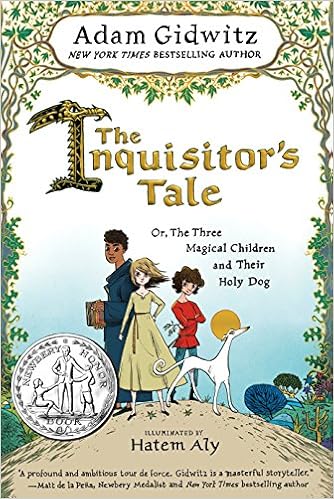
The Inquisitor's Tale by Adam Gidwitz

It should not be surprising that The Inquisitor's Tale is about the Dark Ages, when the Inquisition rooted out and punished anything that the Pope determined was heresy. It is also not surprising that Gidwitz would employ a style of storytelling reminiscent of Chaucer's Canterbury Tales. Each chapter is a tale told by one or other patron of a local inn in rural France. 

What is surprising is that Gidwitz, with six years of research under his belt, does not try to write a history book for children. Instead, he paints a deeply informed picture of the Dark Ages that is also interesting and accessible. He taps in to the corner of the imagination that transcends time and allows someone in the modern information age to truly understand a few of the difficulties and delights of a life 800 years ago. You can trust the background details to be true and accurate of the time period. Yes, the Kings and Queens had a corner of the banquet hall designated for their bladder relief during mealtimes. Yes, peasants slept with their cow at night for warmth. Yes, people from all stations of life gathered at inns to drink ale, warm themselves by a fire, and swap stories till past their bedtime. (Some things never change!) 

The thing I loved most about this book is that I knew I was learning so much about the Dark Ages without even trying. I didn't have to memorize dates or names, but I now know who the king of France was during that time period (and his mother and wife too!) After reading this book, I have a much better sense of what life was like back then. We've gained almost everything. (It was the Dark Ages, after all.) But we've lost things too. Who knows herb lore and which plants can have which effect on the body? (I know some do, but not many!) Who has seen or used a handmade, illuminated book? Who has seen a book that took 40 years to make and was a work of art worthy of sitting next to the Mona Lisa? 

The three children of this story could not have been more unlikely friends. William is a giant of an oblate (basically a monk's understudy) who loved books and learning. Jacob is a Jew which was almost equal to the Devil in that culture. And Jeanne is a peasant girl who has fits in which she sees visions that often show her something of the future. Even so, they are thrown together and they do miracles. ("Really?", you say. Well, it all depends on your perspective, just as it did in the Dark Ages. Maybe they were just normal people. Maybe they were heathen witches. Maybe they were saints doing the work of the Almighty.)

Gidwitz cleverly weaves together truth and tale and produces a legend. A wonderful beautiful legend, illustrating perfectly the Biblical principle: God uses the weak things of the earth to shame the strong; He uses the humble things of the earth to shame the proud. Through the story, he weaves in elements of more Biblical principles: Forgive, love, and care for your enemies. Trust that God sees more than you see, and that there is a reason and maybe even beauty in the pain we experience on earth. (The Troubadour's Tale got it right when he said that God was singing the song of the world. The pain of life and loss of loved ones is never beautiful, but the song that is telling the story might still be....will we trust that it is?) Truly, these are the hard questions of life--not just life in the Dark Ages. They are questions of life now, where terrorists murder, and political battles are full of hatred and blindness, and people are afraid of showing too much of themselves to others. 

William, Jeanne, and Jacob experienced these things in their world. People murdered without reason. (Jacob's parents died this way.) Political battles were blinded by hatred. (William saw the horror of thousands of books being burned and knowledge lost just because the Christians hated the Jews.) And Jeanne. She was afraid of her shadow--the shadow of her fits and dreams and of the people that would burn her as a witch because of what they did not understand.  At any rate, these unlikely friends protect each other and comfort each other through loss and loneliness. And together, they make the hardest choice of all: to do what they believe is right no matter the consequences. This is still a decision children (and adults too) have to make. But back then no one had any "human rights". There was no "social justice." There was no "due process" of law and order. In the culture of the Dark Ages, "Might made right"...with a bit of superstition thrown in. So the rule of the land was more like: "Might makes right and saves your soul from eternal fire and torture where bloodthirsty demons will shred the flesh off your living bones." 

There's something admirable and stunning about someone following truth when "Might" is on the side of the lie. The way these children do. The way we could. Admirable. Or crazy. Either way, it makes a good story. 

Friday, October 2, 2015

Sylvia's First Birthday

Sylvia, Extreme.

     Sylvia's birthday was relatively uneventful. Kate was grateful for that. For one day to outshine a year of change, growth and transition would be overwhelming to the extreme. But Sylvia's birthday was uneventful also because of the down to earth reality of the day. 
     It was Sunday and hot. The day before, they discovered that their car, the mostly indomitable White Rabbit refused to start. Something was up with the igniter. And the hood didn't close all the way. As unlikely as it seemed, the first thing Kate thought of was that someone had tampered with the car. At any rate, they weren't going to walk a mile to church in 90 degrees. And poor Sylvia had a nasty cold, anyway. To inaugurate the beginning of her second year of life, she contracted her first bad cold and also her first case of nasty diaper rash. She was a sloppy, goopy mess, oozing out of both ends. 
     And yet, with some tylenol, baby powder, and Gouda (which makes everyone happier), Sylvia was her usual cheerful and slightly demanding self. She wanted to walk so badly, and only the day before had taken her first steps all on her own. Kate and Mister sat on the floor and let her walk back and forth between them. Step, step, step, poof. A small cloud of baby powder rose in the air every time she sat down. 
     When she wasn't walking, she wanted to be held and read to. Her particular favorites at the moment were all the "color" books. Sylvia requested Brown Bear, Brown Bear so often that Kate made various adaptations to keep her brain from disintegrating.
     "Brown bear, brown bear, what do you see?"
     "Raaaaaaawwwwr."
     "Uh-oh. Brown bear wants to eat the red bird!"
     "Red bird, red bird, where will you go?"
     "Tweet tweet....(red bird has a friend, the yellow duck. He's got connections. Quack.)"

    Teddy enjoyed the books (and variations) as well. Sometimes they disagreed over which book to read, and the ensuing brawl of book whacking often sent Kate hiding behind a barrier of pillows. But on the whole, Kate was pleased to see that both her kids had an approximately equal interest and attention span for books. And even when it wasn't books, they often played well together--though Teddy had the predictable problem of possessiveness. 
    Kate thought back and realized that he had come a long way in the last year. When Sylvia was only days old, and Teddy began to investigate the new creature that had invaded his territory, he quickly lost interest when he discovered that he couldn't chew on her, or sit on her, or whack her with his characteristic enthusiastic arm swings. Gradually, as Sylvia started interacting more--smiling, vocalizing, and grabbing things--Teddy wanted to interact with her too. Kate had been surprised at how easily he learned to be gentle, and she was completely charmed every time he would run up to her after getting up from his nap and put his forehead against hers, or lean over and softly pat her downy head. 
    Now, they tried to chase each other, shared food and water bottles, try to wear each other's clothes (usually around their neck), and of course, fight over toys and books. The non-sharing season would be tough, Kate knew. But every once in a while she saw beautiful glimpses of the fun in store. Sometimes she heard raucous laughter when they woke up from their naps and were entertaining each other. Sometimes they sat close to each other, ignoring the pile of toys around them, babbling back and forth and chuckling. Sometimes they even took themselves away to the play room upstairs, where they would play happily (but not quietly) for 20 or 30 minutes at a time. Then Sylvia would get bored and scream to be carried down the stairs. She could go down the stairs on her own. But there were many of them, and Sylvia was timid about falling or bonking into things.    
     Oh, Sylvia was fearless when it came to climbing. But going down was a different matter. Once, when she realized she wanted to get off the couch, Kate watched her creep to the edge, then gradually maneuver around on her stomach so she could swing her legs down first. In the process, Sylvia slipped and then caught herself. She didn't fall, and she didn't bonk into anything. She was on the couch where she had started. But Kate watched her think and when Sylvia realized how close she had been to falling, her face melted and the tears flowed. 
    In spite of this, Sylvia loved to walk (with help) since she was about 9 months old. Only extreme tiredness would keep her from accepting a proffered hand for a jaunt around the living room. She was even fairly good at cruising along the coffee table, bookcases, or couches, walking along with one hand stabilizing on the furniture.
    The coffee table was invaluable. It was a great height for both kids, perfect for snacks, toys and games, lessons in coloring, and (if you were a Teddy) standing on to look out the window or running along to jump onto a couch. One day, Kate gave them a usual snack of cheerios scatter along the outside of the coffee table. And Teddy, who wanted to play with them by making piles, didn't want to share. He sat in the middle of the table, while Sylvia cruised along the outside. Just as fast as he could gather up the cheerios and move them to another side of the table, Sylvia marched around and snatched a couple. Teddy gave dismayed squeals as she appropriated "his" cheerios, and with a dramatic flare, would follow her hand with his own all the way to her mouth, in the hopes of retrieving his stolen property. When the cheerio disappeared between those impenetrable doors, he hung his head and whimpered as if to say, "lost, lost, all is lost." It's hard to say if Sylvia noticed any of Teddy's drama. If so, they didn't phase her a whit. But that wouldn't have been surprising either, since stubbornness and single-minded purpose were already obvious facets of her character. 
    There was no doubt she was her mother's daughter, Kate and Mister agreed. Even from a few weeks old, they could tell she was a baby of extremes. When she was happy, she was very happy. When sad, very sad. When impatient...so impatient that she hardly realized when her request had been granted. Even her face was extreme. It was cute, certainly, but so are most babies. Sylvia's was a special cuteness--she was a beautiful baby, like a doll, with deep, shiny, jewel-like blue eyes. (Such phrases characterized the compliments of everyone who saw her.) And then she would open her mouth and say, "Ma-ma-ma-ma-ma" in a deep, throaty gremlin growl. Even after almost a year, Kate was still surprised by the contrast of such a growl coming out of such a face. 
    And Kate had no doubts. There were many more surprises ahead.


Wednesday, September 30, 2015

The Beach

The Beach (Aug, 2015)

    Even before moving, Kate and Mister had agreed that one good way to try to learn about New Jersey and New York City would be to have weekly outings--either into the city or some other notable excursion. Before they left on their travels, they had time for two such outings, which were to Central Park (a visually overwhelming experience) and the Staten Island Ferry (busy, but fun--especially chancing upon a jazz band in a park on the way home.) The entire first week they were home after their trip soared into the upper 90s, and both Kate and Mister agreed that it would be a good opportunity to investigate the beaches nearby. 
    There were a number of beaches, but there was one about an hour away that sounded nice, and Kate and Mister made plans to go in a couple days, on Thursday. First thing in the morning, they gathered everything they could think of--umbrella stroller, parasol, towels and blanket, camp chairs, food and milk, sunglasses, and of course sunblock. Even so, before they reached the end of the first block, they thought of something else they had forgotten. Mister drove around the block (they lived on a one way street), and Kate ran inside to get a book to read aloud on the drive. 
    In spite of some audible discontent in the backseat, the drive south was smooth. Instead of going to the state park, they decided to park off a side street for free and walk up to the beach. Sylvia was in the stroller with an absurd number of bags hanging from the handles and swinging around on either side of her. Kate and Mister each carried more bags, and Kate chased after Teddy, who was eager to run into the middle of the road. It wasn't until they made it to the boardwalk that Kate realized it must have been too easy...free parking place, easy beach access...must be too good to be true. They approached a ramp over to the beach, but at the entrance sat a bored teenager with a flawless tan. There was an entrance fee--$10 each. What! Kate scoffed in her mind. But then she looked down. Teddy was wriggling. Her bags were sliding down her arms to her wrists, Sylvia's stroller was so laden down, they could barely steer. She sighed. Expediency was definitely becoming more valuable--yet another evidence of her old age......err....maturity. 
    The beach was lovely and clean. And in spite of the heat, the water still felt quite cool. There was also a terrific breeze, which kept you cool and gave the ultimate sandy experience. Kate and Mister spread out a blanket and dropped a bag on each corner. In five minutes (or less) there was sand in their hair and diapers, at the bottom of bags, covering snacks and bottles, and also the proper place--between their toes. 
    For the next 2 hours, the kids played in the sand and the water, running back and forth and digging and getting their feet wet. (Sylvia would walk as far as anyone would help her!) Then they took turns returning to home base for a sandy snack, a sandy bottle of milk, and a quiet rest time buckled into the stroller. Kate fashioned an ingenious (and invaluable!) little shelter from the wind by hooking her little parasol around the back of the stroller. They didn't actually take naps, but were certainly better for having a short rest and were ready to go again for another hour after they were done. In spite of the obvious lack of naps, the sand, and the wind, Teddy and Sylvia clearly had a fabulous time. There was no crying or complaining. Even the seagulls were entertaining when they crept up within kicking distance in order to steal some abandoned crackers. 
    Finally, Kate and Mister decided it was time to head home. They packed everything up, dragged everything through the sand back to the boardwalk, changed babies, got fresh bottles, and loaded up the car. All in all, Kate felt like it had been a very successful trip--though it still rankled her that they had paid $20 to go to a beach which had half a zillion lifeguards and no bathroom! 
    In the coming days and weeks, Mister was less enthusiastic about their "successful" trip to the beach. He had put sunscreen on his shoulders, but in the flurry of taking care of the kids, he had forgotten to ask Kate to cover the middle of his back. Twenty minutes after they got home, he approached Kate with a sheepish grin, "Do you know if we have any aloe vera gel?" Kate looked at his back and was horrified--truly, a lobster red; the worst burn that she had ever seen made an interesting map-like design across the middle of his back. A week later, when the worst of the itchiness was finally subsiding, Kate tried to remind Mister that it actually had been a good and fun trip to the beach. 
    "Remember how the kids didn't complain at all? And they slept so hard and so long that night?" 
    With a noncommittal grunt, Mister assented that the kids had a good time, but there was a meaningful silence afterward.